BTA2023
 The project is part of GhanaCARES’s ‘Obaatanpa‘ campaign, which aims to empower youth and cultivate digital skills. It is scheduled to be completed in December 2024.
During a site visit to assess building progress, the Vice President emphasised the importance of digitalisation for economic growth, pointing out that countries that capitalise on the Fourth Industrial Revolution will create long-term jobs.
“All empirical evidence suggests a direct beneficial relationship between digitisation and economic growth. “It is critical that Ghanaian youths acquire the necessary skills to participate in this new era,” he stated.


According to him, the government’s commitment to empowering young people and making sure the nation stays ahead of the curve in the global transition to a knowledge-based economy is demonstrated by the Digital Youth Hub, which is a tribute to the government’s ongoing investments in the country’s digital future.
“A significant step towards realising this vision will be the December commissioning of Phase 1,” he continued.
Positioning Ghana as a digital hub for the African continent includes a larger strategy that includes the Digital Youth Hub. In addition to encouraging entrepreneurship, the Vice President underlined that this program will draw in foreign investment and establish Ghana as a competitive participant in the digital economy.
“Our goal of teaching one million young people digital skills highlights the scope of the government’s aspirations. Global players are welcome to lead our efforts and serve as our benchmarks against the finest in the world, the speaker stated.
In just six months, the hub’s development has advanced remarkably, and it will provide a focal point for entrepreneurship, digital innovation, and capacity building.
Phase 1 of the initiative is expected to be finished by December 2024, according to Dr. Bawumia. There are also plans to expand it to universities around the nation, such as Kwame Nkrumah University of Science and Technology (KNUST), University of Cape Coast (UCC), and University for Development Studies (UDS).
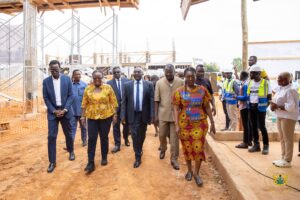
The first phase, scheduled for commissioning on December 1, 2024, will be followed by a second phase that includes the construction of hostel facilities to house students from throughout the nation. This was confirmed by Finance Minister Dr. Mohammed Amin Adam, who also paid a visit to the site.
The minister pointed out that until centres of a comparable kind are developed in other locations, this will permit broader participation.
The infrastructure to give skills to as many Ghanaian youngsters as feasible would eventually be dispersed by UCC, KNUST, and UDS, according to Dr. Amin Adam.
In addition to serving as a centre for digital skills, the hub will serve as a regional hub for conferences and events thanks to its 2,200-seat conference room.
The Finance Minister emphasised that the hub is being designed with Silicon Valley in mind, hoping to draw in high-tech companies and promote cooperation between government, business, and academia.
Dr. Amin Adam added, “We are also setting up an endowment fund of US$5 million to support the management and planning of this hub.”
The hub’s objective is consistent with Ghana’s broader agenda of supporting digital innovation and industrialisation. Both the Vice President and the Finance Minister highlighted that the project is intended to keep Ghana competitive in the global digital economy. The government sees the centre as an important component in producing jobs and driving economic growth, especially among the country’s youth.
The Digital Youth Hub is expected to be a centre of excellence for digital skills training, research, and innovation, not only for Ghanaians but also for young people from across the region.
By providing the necessary infrastructure, resources, and training, the government intends to foster an inclusive digital ecosystem that will allow young people to flourish in the global digital economy.